


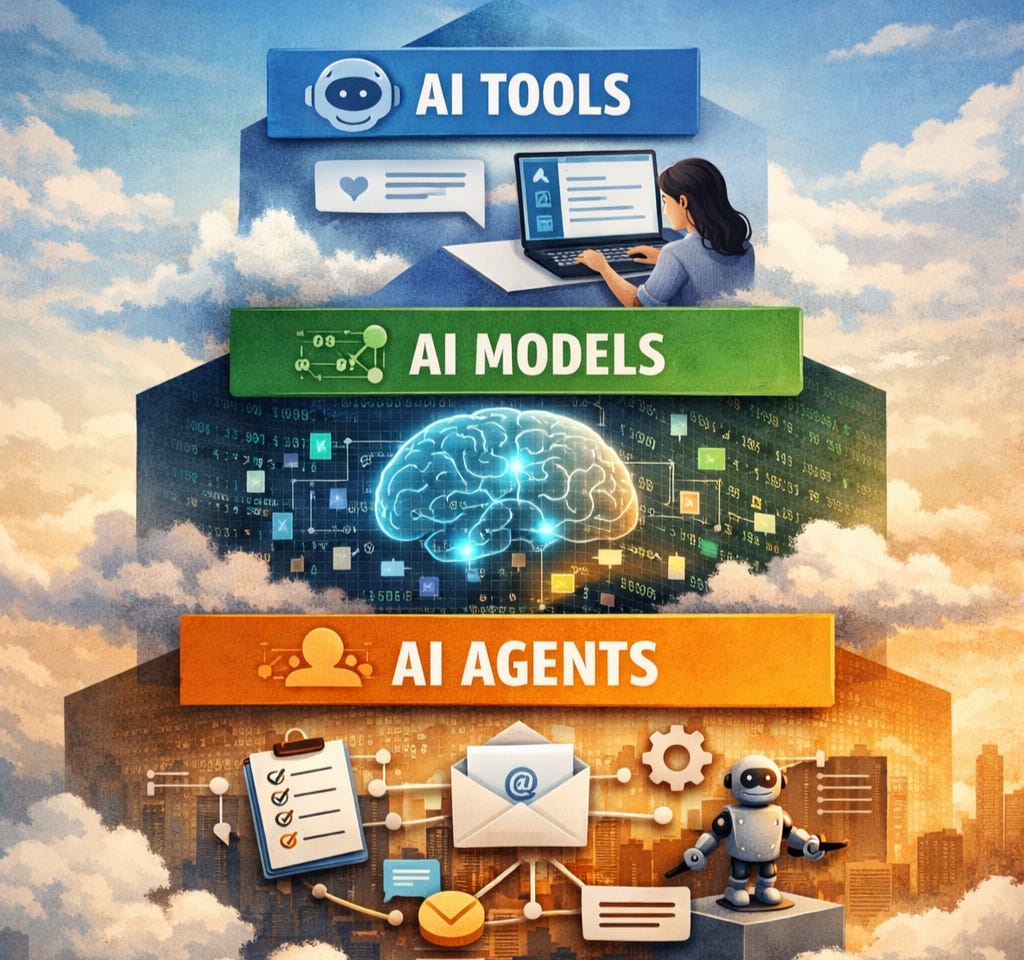
AI Tools, Models, and Agents Explained
Most people use AI without really understanding what’s happening under the hood.
You type something into ChatGPT or Claude, get a response, and move on.
But underneath that simple chat box are three very different layers of intelligence: AI tools, models, and agents.
Let’s break them down clearly.
AI Tools: The Chat Layer
AI tools like ChatGPT and Claude are what users directly interact with.
They are designed with a simple interface: a chat box.
At the core of these tools is a large language model (LLM) — the actual “brain” generating responses.
But there’s an important limitation:
These systems are fundamentally stateless.
This means every message is processed independently. The model does not naturally remember past conversations.
So the interaction looks like this:
You ask → it answers
You ask again → it answers again
You repeat → it responds again
Each response is generated from scratch.
Why Memory Changed Everything
To solve this limitation, AI systems introduced memory layers.
Memory allows the system to:
Store previous context
Remember user preferences
Connect past and present conversations
With memory, conversations feel continuous instead of disconnected.
Without it, every message feels like starting over.
What AI Tools Are Good At
AI tools are powerful, but they are best used for interactive exploration, such as:
Writing code
Generating ideas
Creating documents
Testing concepts
This workflow has led to a new behavior known as “vibe coding”.
A typical pattern looks like this:
You prompt → you review → you copy → you refine → you repeat
It’s fast, flexible, and creative — but heavily dependent on the user.
Because ultimately:
You are the orchestrator, not the system.
The Limitation of AI Tools
AI tools don’t complete workflows — they assist them.
That means:
You decide what to ask
You validate outputs
You connect the pieces
They are powerful assistants, but not autonomous systems.
Subscription Models: UI vs API
AI systems are delivered in two main ways.
1. UI Subscriptions (For Users)
These are the tools people interact with directly.
Examples include:
ChatGPT (Free, Plus, Pro)
Claude (Free, Pro, Max)
These are designed for:
Writing
Thinking
Learning
General productivity
2. API Subscriptions (For Builders)
APIs are designed for developers building systems.
They are used to create:
AI agents
Automation workflows
Backend systems
Instead of chatting, you program the model.
AI Models: Different Brains for Different Tasks
Not all models are the same. Each is optimized for a specific tradeoff between speed, cost, and intelligence.
OpenAI-style model tiers
Pro models → strongest reasoning, slow and expensive
Base models → balanced performance
Mini models → faster and cost-efficient
Nano models → ultra-cheap, high-volume tasks
Additional specialized models exist for:
Image generation
Audio processing
Video generation
Deep research
Coding
Anthropic Model Family
Opus → most powerful reasoning
Sonnet → balanced performance
Haiku → fast and lightweight
Choosing the right model is not just technical — it directly impacts cost, speed, and quality.
AI Agents: From Tools to Systems
AI agents are where things become fundamentally different.
An AI agent is:
A system that can think, plan, and act autonomously toward a goal.
Instead of responding to single prompts, it operates in multiple steps:
Understands the goal
Plans actions
Uses tools
Executes tasks
Adjusts based on results
You give it:
A goal
Access to tools
A reasoning model
And it handles the execution.
What Tools AI Agents Can Use
AI agents become powerful when connected to external systems like:
Google Sheets → manage structured data
Gmail → send emails
Slack → notify teams
This turns AI from a chat assistant into an operational system.
System Prompts vs User Prompts
There are two ways to control AI behavior:
User Prompts (AI Tools)
You give instructions directly:
“Write this”
“Generate that”
“Explain this”
System Prompts (AI Agents)
You define behavior rules:
How the agent thinks
How it uses tools
What constraints it follows
System prompts are powerful — but fragile.
Too strict → the agent breaks or fails tasks
Too loose → the agent becomes unpredictable
The balance defines whether an AI agent is useful or unreliable.
Multi-Agent Systems
Once you go beyond a single agent, you enter multi-agent systems.
This is simply:
Multiple AI agents working together as a system.
Each agent may have:
A specific role
A specific toolset
A specific objective
Together, they form a coordinated intelligence layer capable of handling complex workflows.
Final Thought
AI is not one thing.
It is a layered system:
Tools → interaction layer
Models → intelligence layer
Agents → execution layer
Understanding this separation is the key to building real AI systems — not just using chatbots.